
Updated October 15, 2026 · 5 min read · By ShortDrama Studio Editorial Team
Micro drama market 2026: size, growth and key players
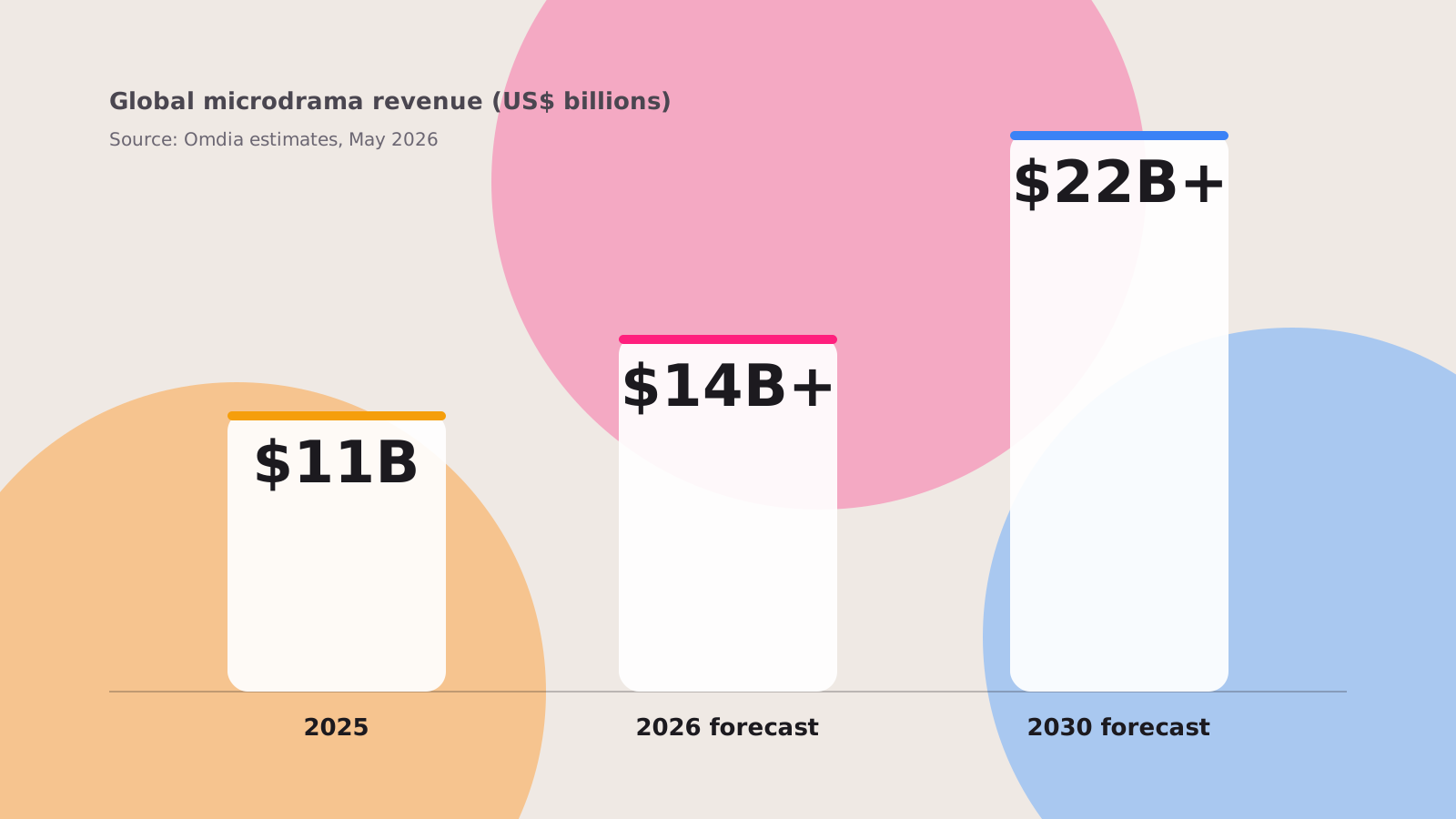
The micro drama market, the business of vertical short-drama series watched on phones, is one of the fastest-growing parts of entertainment. Omdia estimates that global microdrama revenue reached about $11 billion in 2025 and will pass $14 billion in 2026, with more than $22 billion forecast by 2030. Most of that money still comes from China, but the apps that took the format abroad, led by ReelShort and DramaBox, have turned it into a global industry in under three years.
Key takeaways
- Omdia puts global microdrama revenue at about $11 billion in 2025, over $14 billion in 2026 and over $22 billion by 2030.
- China is the largest market. Media Partners Asia puts Chinese micro-drama revenue at about $9.4 billion, more than the country's box office.
- Outside China, the US is the biggest audience, with about 66 million monthly active users in 2025 (Omdia).
- ReelShort and DramaBox lead the international app market; NetShort, ShortMax, GoodShort and DramaWave are growing fast behind them.
- Brands and studios are moving in, from branded series to Hollywood partnerships, while AI is cutting the cost of production.
All figures on this page are estimates from research firms and the press. Sources disagree, partly because they measure different things (gross consumer spend, app-store purchases or net revenue), so each number below names its source.
How big is the micro drama market?
| Measure | Figure | Source |
|---|---|---|
| Global microdrama revenue, 2025 | About $11 billion | Omdia |
| Global microdrama revenue, 2026 | Over $14 billion (forecast) | Omdia |
| Global microdrama revenue, 2030 | Over $22 billion (forecast) | Omdia |
| International share by 2030 | Nearly one-third of revenue | Omdia |
| China micro-drama revenue | About $9.4 billion | Media Partners Asia |
| Ex-China quarterly revenue, Q3 2025 | About $800 million | Owl & Co. |
Omdia's figures were presented in May 2026 and reported by Advanced Television. The Media Partners Asia and Owl & Co. figures are compiled in Vitrina's 2026 market guide.
Where the audience is
China built the format and is still its largest market: short dramas (duanju) are watched inside apps such as Douyin, Kuaishou and dedicated players. Outside China, the audience is spread across the Americas, Europe and Southeast Asia.
| Market | Monthly active users, 2025 | Source |
|---|---|---|
| United States | About 66 million | Omdia |
| United Kingdom | About 8.2 million | Omdia |
| Germany | About 4.4 million | Omdia |
Latin America is also a major market: industry reports name Brazil and Mexico among the largest micro-drama audiences outside China, and both are among ReelShort's top download countries. In Southeast Asia, viewers lean more towards free, ad-supported viewing than paid unlocks.
The leading short drama apps
A handful of apps account for most international spending. Sensor Tower data cited by Vitrina puts ReelShort at over $490 million and DramaBox at over $450 million in cumulative in-app revenue by March 2025. Earlier, Appfigures data reported by TechCrunch showed ReelShort at $52 million and DramaBox at $35 million in the first quarter of 2024 alone.
- ReelShort, published by New Leaf Publishing (Crazy Maple Studio, part of COL Group), the app that broke the format in the US.
- DramaBox, published by Storymatrix, the closest rival and the leader in several markets.
- NetShort, ShortMax, GoodShort and DramaWave, the fast-growing challengers.
- PineDrama, TikTok's own short-drama app, a sign that the big platforms want the format in-house.
See the full list, with links, in the best short drama apps, and the head-to-head in ReelShort vs DramaBox.
How the market makes money
Short-drama apps combine several models, often in the same app:
- Pay per episode. The first episodes are free; the rest are unlocked with coins.
- Subscriptions. A weekly or monthly pass unlocks the whole catalogue.
- Ads. Viewers watch ads to unlock episodes, or the app is free and ad-supported. In China, advertising is expected to become the largest revenue source.
- Brand partnerships. Brands fund series built around their products (see micro drama advertising).
Growth is expensive. Apps spend heavily on user acquisition, mostly through social media ads that show a series' most dramatic cliffhanger. According to eMarketer, citing Sensor Tower, about 68% of US acquisition spend for these apps runs through social media.
What is driving the growth
- Phone-first habits. Viewers trained by TikTok, Reels and Shorts want stories that fit in a minute and continue in the next.
- The binge mechanic. Every episode ends on a cliffhanger, and the paywall sits right after the hook has landed.
- Low production costs. A whole series is shot in days on a fraction of a TV budget, so studios can release many titles and keep the winners.
- Familiar stories. Billionaires, revenge, werewolves and hidden identities, the tropes that sold romance novels, now sell episodes.
- AI production. AI writing, casting, video and dubbing tools cut the cost of a series further and let one creator test ideas that once needed a crew.

Challenges and risks
- Acquisition costs. Much of the revenue goes straight back into ads, so many apps are growing faster than they are profiting.
- Regulation. Chinese regulators have tightened content and licensing rules, and platforms have removed titles after reviews.
- Quality and fatigue. Repetitive plots and low production values limit how far the format can grow beyond its core audience.
- Conflicting data. Revenue figures vary widely between sources, so treat any single number with care.
What it means for creators and brands
For creators, the market means demand: apps need hundreds of new series a year, and social platforms reward serialized stories. For brands, it is a new kind of advertising that viewers choose to watch. In both cases, the cost of making a series is falling, which is where AI short drama tools come in.

Make a series for the micro drama boom
ShortDrama Studio turns one sentence into a vertical drama series: it writes, casts, films and edits every episode, and you approve each step.



FAQ
How big is the micro drama market?
Omdia estimates global microdrama revenue at about $11 billion in 2025 and forecasts more than $14 billion in 2026 and more than $22 billion by 2030. China accounts for most of it, with Media Partners Asia putting Chinese revenue at about $9.4 billion.
Which country is the biggest micro drama market?
China is the largest market by far. Outside China, the United States is the biggest audience, with about 66 million monthly active users in 2025 according to Omdia, followed by large audiences in Brazil, Mexico and Southeast Asia.
Which micro drama app makes the most money?
ReelShort and DramaBox lead the international market. Sensor Tower data puts their cumulative in-app revenue at over $490 million and $450 million respectively by March 2025.
How do micro drama apps make money?
Mostly by selling coins to unlock episodes and weekly or monthly subscriptions, with ads and brand partnerships as growing sources of revenue.
Is the micro drama market still growing?
Yes. Omdia forecasts the global market to grow from about $11 billion in 2025 to more than $22 billion by 2030, with international markets taking a larger share over time.